Airbnb Minimum Stay: Everything You Need to Know to Maximize Revenue and Guest Satisfaction
.webp?u=https%3A%2F%2Fimages.ctfassets.net%2Fpqmtoyw9z10u%2F1yIjaNymg6kf0rclLyEpFH%2F7ef35bfc178f8a2f9a36bc9482923dcd%2Ffabio-spano-_2e6rV76Mlg-unsplash__1_.webp&a=w%3D960%26h%3D540%26fm%3Dwebp%26q%3D75&cd=2025-12-17T11%3A42%3A39.069Z)

Key Takeaways
Your Airbnb minimum stay policy has a direct impact on revenue, occupancy, cleaning costs and guest quality — and should be adjusted intentionally, not set once and forgotten.
The most profitable approach is dynamic, adapting minimum night requirements based on seasonality, demand, local events, weekends and booking lead times.
Longer minimum stays help maximize earnings during peak seasons and major events, while shorter stays keep bookings flowing during off-season or in hotel-competitive markets.
Cleaning costs, traveler type and the risk of gap nights play a critical role in shaping the optimal minimum stay strategy.
Airbnb allows hosts to create custom minimum stay rules, giving hosts control to tailor policies for both revenue and occupancy success.
Your minimum stay policy is one of the most powerful but often overlooked levers for maximizing vacation rental revenue.
Many hosts lose potential income because their minimum stay settings are misaligned with real market demand, guest behavior or operating costs. Others adopt a rigid approach that either limits bookings unnecessarily or increases turnover costs without improving profitability.
Minimum stay rules also play an important role in guest management. They can help deter higher-risk bookings, such as one-night stays associated with parties. Airbnb itself enforces minimum stay requirements around high-risk dates like New Year’s Eve to reduce unauthorized events.
Understanding how to strategically design, customize and adjust your Airbnb minimum stay policy is essential for building a profitable and sustainable hosting business.
What Is a Minimum Stay?
A minimum stay, also referred to as a minimum night stay or minimum length of stay, is the minimum number of nights a guest must book to complete a reservation at your property.
This requirement applies to each reservation request and can vary by date, day of the week, season or special event depending on how your availability settings are configured.
Understanding Guest Preferences and Booking Behavior
An effective minimum stay strategy starts with understanding how different guest segments book and what they expect.
Business travelers, especially in urban markets, tend to book shorter stays, often on weekdays and with shorter lead times. These guests value flexibility and convenience and may be discouraged by longer minimum stay requirements.
Leisure travelers, on the other hand, usually book longer stays, plan further in advance and are more tolerant of higher minimum night requirements, particularly in vacation destinations.
Market dynamics also matter. In destinations where Airbnb vacation rental listings compete heavily with hotels, allowing shorter stays can improve conversion rates. However, this flexibility can increase turnover and elevate the risk of problematic bookings, making guest screening and rule enforcement more important.
Your minimum stay policy directly influences guest satisfaction and reviews. Overly restrictive rules can reduce booking interest, while overly flexible rules may increase workload and operational costs. The goal to setting minimum nights rules is balance.

How to Set the Optimal Minimum Night Stay for Your Airbnb
There is no one-size-fits-all rule for Airbnb minimum stay settings.
Some hosts opt for one-night minimum stays year-round. Others require week-long or even month-long bookings. Many default to two- or three-night stays and never revisit the setting.
The most profitable approach is proactive and dynamic.
Before setting your minimum stay, consider:
Market demand and booking patterns
Seasonal fluctuations
Local events and festivals
Destination type (urban vs. resort)
Property type and size
Many professional hosts also rely on vacation rental software and revenue optimization tools to automate minimum stay rules based on demand, lead time, and seasonality, reducing manual adjustments while maximizing revenue.
HipHipStay relies on this kind of automation across its international portfolio, using Hostaway's dynamic pricing tools to adjust rates by demand rather than manually revisiting settings property by property.
High season strategy and peak demand
During peak seasons such as summer holidays, ski season or festive periods like Christmas, demand is high and availability is limited.
Setting longer minimum stays during these periods allows you to:
Maximize total booking value
Reduce the risk of one-night stays blocking longer, higher-paying reservations
Minimize unbooked gap nights
Event-driven demand amplifies this effect. Major festivals, conferences or sporting events create short-term demand spikes. Increasing your minimum stay during these windows helps capture higher-value bookings.
For example, AirDNA data shows that during Austin’s 10-day South by Southwest (SXSW) festival, listings with three-night minimum stays earned the highest revenue, followed closely by properties with four- to six-night minimums.
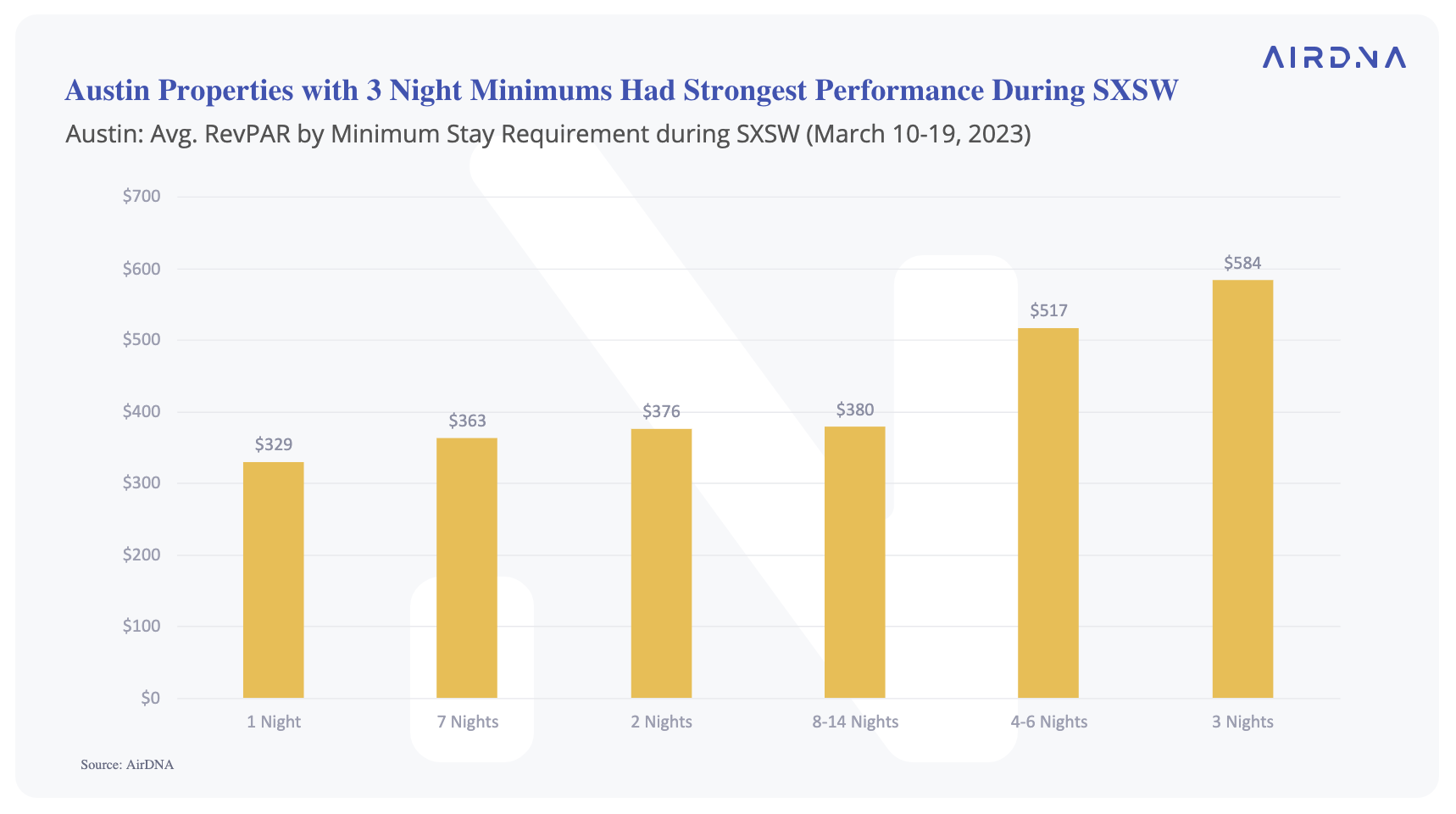
Your Airbnb minimum stay policy is a key component of ensuring high season success.
Off-season minimum stay strategy
In low-demand periods, flexibility becomes more important than exclusivity.
Reducing your Airbnb minimum stay length during off-season months — even allowing one-night stays where feasible — can help maintain consistent booking flow and reduce vacancy.
Shorter minimum stays are particularly effective in:
Shoulder seasons
Urban markets with transient demand
Destinations with strong weekday travel
While shorter stays increase turnover, they often outperform rigid longer minimums during slower periods by keeping your calendar active.
Booking lead time adjustments
Minimum stay settings do not need to be static across your entire booking window.
For reservations made far in advance, longer minimum stays can help secure more profitable bookings and reduce calendar fragmentation.
As the check-in date approaches, lowering the minimum stay can help fill last-minute availability that might otherwise remain vacant.
Looking at historical booking data, analyzing market trends and using common sense allows you to tailor minimum stay rules to different lead-time windows and maximize occupancy.
Market-based minimum stay policy
Market Type | Competitive Pressure | Recommended Strategy | Risk to Watch |
Urban / city center | High (hotels) | Shorter stays, weekday flexibility | Higher turnover |
Resort destinations | Low | Longer minimum stays | Gap nights |
Seasonal markets | Medium | Dynamic seasonal rules | Calendar fragmentation |
Rural / remote | Low | Longer stays year-round | Reduced demand |
Event-driven cities | High during events | Event-based custom rules | Overblocking non-event demand |
Airbnb Minimum Stay Policy and Requirements
Airbnb gives vacation rental hosts extensive control over trip length settings.
You can set:
Minimum number of nights
Maximum stay lengths
Custom rules for specific dates, seasons or weekdays
Airbnb applies rule hierarchy automatically. If multiple minimum stay rules apply to the same date, the most specific rule takes precedence.
For example, if your listing has a general one-night minimum but a three-night minimum for weekends, a Friday check-in will require a three-night stay.
How to customize your booking settings with Airbnb custom rules
Custom rules allow you to fine-tune your Airbnb minimum stay strategy without limiting flexibility.
You can create rules to:
Require longer stays on weekends
Increase minimum stays during peak seasons
Set event-specific minimum nights
Allow one-night stays on select weekdays
Weekend minimums are particularly effective. Treat weekends as the “high season” of the week by requiring two- or three-night stays, preventing underutilized single-night bookings.
Custom rules also allow you to accommodate unique patterns, such as allowing one-night Friday check-ins while maintaining longer stays on Saturdays.
How to set your minimum stay policy on Airbnb
To set minimum night booking requirements on your Airbnb listing:
Go to Your listings and select your listing
Click Manage listing
Click Availability
Next to Trip length click Edit
Enter minimum night requirements
To create custom rules for each day of the week, click Customize by day of the week.
To set minimum nights for a specific date or season, click Add a custom rule for seasons or specific dates.
Balancing Revenue, Cleaning and Turnover Costs
Cleaning and turnover costs are a critical factor in minimum stay decisions.
Cleaning fees are charged once per booking. A $100 cleaning fee spread across a five-night stay reduces turnover costs and is far more efficient than five separate one-night bookings each requiring turnover.
However, if you self-clean and treat cleaning as part of your income, longer stays may actually reduce total earnings by lowering the number of paid turnovers.
Longer minimum stays also increase the risk of gap nights. For example, a five-night minimum may leave three-night gaps between bookings that cannot be filled.
Optimizing minimum stay rules to reduce gaps and balance turnover is essential for long-term profitability.
Minimum Stay Length | Turnover Frequency | Cleaning Cost Efficiency | Revenue Impact |
1 night | Very high | Low | High occupancy, lower net profit |
2 nights | High | Moderate | Balanced approach |
3–4 nights | Moderate | High | Strong revenue-to-effort ratio |
5+ nights | Low | Very high | High booking value, risk of gaps |
Managing Guest Expectations and Communication
Clear guest communication helps prevent confusion and improves guest satisfaction.
Your minimum stay policy should be clearly stated in:
Your listing description
House rules
Pre-booking messages
Saved replies can help explain event-based or seasonal minimum stays quickly and professionally.
Guest feedback is also valuable. If guests frequently ask about flexibility or express frustration, it may be time to revisit your settings.
Understanding the Impact of Minimum Stay on Guest Management
Minimum stay settings influence not just revenue, but guest quality.
Shorter stays can increase turnover and operational workload, while longer stays often result in fewer check-ins, reduced wear and tear, and more predictable operations.
Minimum stay rules can also deter undesirable bookings, particularly during high-risk dates or weekends.
Strategic customization allows you to attract the right guests while maintaining control over your property.
Airbnb Minimum Stay Success
Optimizing your Airbnb minimum stay policy is not about choosing a single “best” number. It’s about adapting intelligently to market conditions, guest behavior and operational realities.
Dynamic minimum stay strategies, supported by custom rules, seasonal adjustments, and lead-time flexibility, consistently outperform rigid, static policies.
By aligning your minimum stay settings with demand patterns, cleaning costs and guest expectations, you can increase occupancy, boost revenue, and create a smoother hosting experience for both you and your guests.
FAQs
How do I create custom rules for minimum stays on Airbnb?
You can create custom rules directly in Airbnb’s availability settings to control your minimum stay length by date, season or day of the week. This allows you to increase minimum nights during peak periods or events while offering more flexible stays during slower times. Custom rules help you balance occupancy, revenue and guest demand without applying the same policy year-round.
What is the ideal minimum stay length for an Airbnb listing?
The ideal minimum stay length depends on your market, property type and guest profile. Vacation destinations often perform best with longer stays, while urban or hotel-competitive markets benefit from shorter minimum night stays. Rather than choosing one fixed number, most hosts see better results by adjusting minimum stay settings based on seasonality and demand.
Is a one-night minimum night stay a good strategy?
A one-night minimum night stay can work well during off-season periods, particularly in seasonal markets, or in cities with strong short-term demand. However, it increases turnover and cleaning costs. Many hosts limit one-night stays to weekdays or to fill last-minute gaps while requiring longer stays on weekends or during high-demand periods.
How do minimum stay settings affect business travelers?
Business travelers typically prefer shorter stays, book closer to check-in, and travel mainly on weekdays. Listings that allow flexible minimum stay settings based on weekdays are more likely to attract this segment. Requiring long minimum stays year-round may discourage business travelers and reduce midweek occupancy.
How does Airbnb minimum night policy impact bookings and revenue?
Your Airbnb minimum night requirements directly influence booking volume, guest quality and revenue. Setting minimum stay settings based on demand, lead time and seasonality helps prevent unbooked gaps, reduce unnecessary turnover and attract the right type of guests for your property. Dynamic minimum stay policies consistently outperform static ones.
Ready to find out how Hostaway can transform your business?